
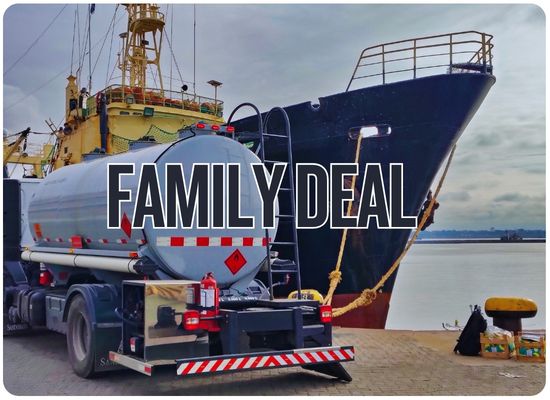

Testing the price before shareholders vote
Related-party vessel deals are not automatically bad deals. But when the seller is connected to the executive running the buyer, “the ship is worth what the broker says” is not enough. Price, process, delivery terms, management fees and shareholder protections all have to survive a much harder test.
Buying a ship from a stranger is primarily a valuation exercise. Buying a ship from the CEO’s family is a valuation exercise and a governance exercise.
The hull can be excellent. The strategic rationale can be sound. The price can even be exactly right.
But ordinary market discipline is weaker when the people on both sides of the transaction are connected.
That means shareholders need evidence that the company behaved as though the seller were a stranger: independent decision-makers, independent price evidence, real negotiating leverage, transparent economics and a genuine ability to say no.
StealthGas is a useful real-world case study.
The Nasdaq-listed LPG owner has agreed to acquire four relatively new LPG carriers from entities affiliated with members of the family of CEO, president, CFO, director and largest shareholder Harry Vafias. The aggregate price is $254.593 million.
The company says its independent-director transaction committee based the price on the average of independent vessel valuations and voluntarily made completion subject to shareholder approval.
Start by separating “related party” from “bad deal”
The conflict increases the burden of proof. It does not determine the answer.
Why the deal could make strategic sense
StealthGas would add 102,000 cbm of LPG capacity, increasing fleet capacity about 35%, while lowering average fleet age from roughly 12.1 years to 10.8 years.
Why shareholders should ask more questions
The sellers are family-affiliated entities, the related manager earns transaction and continuing management fees, and the purchase consumes an amount of capital roughly comparable with the company’s substantial current cash position.
What exactly is being purchased?
| Vessel | Built | Capacity | Type | Build Country |
|---|---|---|---|---|
| Eco Enchanted | 2024 | 40,000 cbm | Fully refrigerated | South Korea |
| Eco Merlin | 2023 | 40,000 cbm | Fully refrigerated | South Korea |
| Eco Nebula | 2026 | 11,000 cbm | Fully pressurized | Japan |
| Eco Texiana | 2025 | 11,000 cbm | Fully pressurized | Japan |
The filed MOA states one $254,593,270 en-bloc price.
It does not publicly allocate $X million to Eco Enchanted, $Y million to Eco Merlin and so on.
Independent valuation is easier to test when shareholders can see the valuation of each asset. An en-bloc figure makes it harder to determine whether one vessel is being acquired cheaply while another is carrying an unusually high price.
Independent valuation is the first layer—not the last
The proxy says the transaction committee based the purchase price on the average of independent valuations.
That is meaningful protection. But investors should understand what an independent ship valuation actually proves.
| Protection | What It Tests | What It Does Not Automatically Prove |
|---|---|---|
| Broker valuation | Estimated open-market vessel value | That buying the ship is strategically better than alternative uses of company cash. |
| Two or more independent valuations | Reduces dependence on one broker’s assumptions | That advisers had no conflicts or that every deal term is fair. |
| Fairness opinion | Broader financial fairness of transaction consideration | That the transaction is the best available strategy. |
| Market check | Whether similar ships can be sourced elsewhere | Future earnings or residual value. |
| Shareholder vote | Investor acceptance of disclosed transaction | That the underlying valuation work was correct. |
Important: the current proxy does not say “two broker valuations.”
It says the purchase price was based on the average of independent valuations. The publicly filed proxy does not identify the valuers, state their individual conclusions, disclose their methodologies or specify the number of valuation reports.
A good valuation should survive three different market tests
Comparable secondhand sales
Recent sales of similar-size, similar-age, similarly equipped LPG carriers are usually the cleanest reality check.
Replacement cost
Compare the price with what an owner can contract today for comparable new tonnage, then adjust for delivery delay, yard, specification and immediate earnings.
Income approach
Estimate normalized charter earnings, OPEX, drydock, residual value and cost of capital rather than relying on today’s strongest freight rate.
Specification adjustment
Korean versus Chinese construction, dual-fuel capability, ammonia readiness, cargo systems, fuel efficiency and charter-free status can move value materially.
Capital Clean Energy Carriers previously disclosed contract prices of roughly $65.3 million for 40,000-cbm Chinese MGCs and $78.1 million for 45,000-cbm Hyundai Mipo MGCs. Those are not direct comparables to the StealthGas vessels—but they show why yard, size, propulsion and delivery date must be normalized before anyone says a family transaction is “at market.”
The independent committee matters as much as the valuation
Nasdaq’s related-party rule calls for review and oversight by an audit committee or another independent board body.
StealthGas created a transaction committee consisting of its independent directors.
But the strongest committee process asks more than: “Do independent brokers say these ships are worth $254 million?”
The shareholder vote adds protection—but examine what kind
StealthGas states that shareholder approval is not required by applicable law, stock-exchange rule or regulatory requirement, but the committee and board voluntarily made it a closing condition.
The December 11 special meeting requires a majority of votes properly cast for and against.
Why the vote helps
It exposes a major related-party capital-allocation decision to public shareholder scrutiny instead of leaving approval entirely inside the boardroom.
What investors should still check
The proxy describes a majority-of-votes-cast test. It does not describe the proposal as requiring approval by a separate majority of unaffiliated or disinterested shareholders.
That distinction matters because Vafias was reported as beneficially owning about 33% of common shares as of April 1, 2026.
The price is only one related-party payment
The affiliated management relationship makes this transaction more interesting than a simple seller-buyer conflict.
| Related-Party Payment | Current Agreement | Illustrative Effect on Four Ships |
|---|---|---|
| Acquisition fee | 1.0% of vessel contract price | ≈ $2.546M on $254.593M. |
| Daily management | $440/day for typical voyage/time-charter vessel | ≈$642,400/year for four vessels if all four are charged at that rate. |
| Commercial commission | 1.25% of gross freight, demurrage and charter hire collected | Scales directly with future vessel revenue. |
| Crew-management fee | $2,500/month on vessels where the arrangement applies | Potential additional recurring related-party payment. |
A related-party acquisition should be evaluated on total lifetime economics, not only the purchase price. Buying the vessel can also expand future fees paid to entities connected to the same family.
The payment terms may actually benefit the buyer materially
StealthGas reports more than $270 million of cash, cash equivalents and short-term investments and says its current vessels are debt-free.
Yet the MOA gives the buyer an unusual option: payment can be made up to one year after the November 4, 2026 MOA date without interest.
If a buyer can retain hundreds of millions of dollars for months without paying interest, that financing concession has real economic value and should be considered together with the headline vessel price.
At a simple 6% annual opportunity cost, $254.6 million held for a full year would represent roughly $15.3 million of financing value. Actual value would be lower if payment occurs earlier and depends on the individual vessel delivery dates.
“Charter-free delivery” deserves a closer read
The proxy tells shareholders that the four vessels are expected to be delivered on a charter-free basis by no later than September 2027.
But the actual filed MOA contains an additional provision stating that the sellers have the option to sell a vessel with its time charter attached, subject to the charterer’s approval of the ownership change.
This does not necessarily mean the two documents conflict economically.
The parties may currently expect charter-free delivery while preserving contractual flexibility to transfer a charter if everyone agrees. But investors evaluating fairness should reconcile the two descriptions.
A ship delivered charter-free gives StealthGas immediate control over employment.
A ship delivered with an attached charter could be more valuable or less valuable depending on the charter rate, duration, counterparty and current market.
The MOA contains other terms worth pricing
Why simply dividing $254.6M by four is useless
The average is about $63.6 million per ship.
That number tells investors almost nothing.
Two vessels are 40,000-cbm fully refrigerated Korean MGCs. Two are 11,000-cbm fully pressurized Japanese ships. Their age, earning capability, replacement cost and buyer universe differ substantially.
Ask for a valuation bridge: individual appraised value → charter adjustment → delivery-date adjustment → technical adjustment → final allocated purchase price.
The 15 questions an investor should ask
A useful governance hierarchy
| Protection | Strength | Why |
|---|---|---|
| Management says price is fair | Weak | The conflict remains inside the decision. |
| One outside broker valuation | Better | Independent evidence, but one methodology. |
| Multiple independent valuations | Strong | Reduces single-appraiser dependence. |
| Independent committee with negotiating power | Stronger | Addresses both price and process. |
| Independent committee + detailed fairness work + market check | Very Strong | Tests price, alternatives and transaction economics. |
| Above + informed disinterested shareholder approval | Highest Confidence | Adds approval from investors not economically tied to the seller. |
So how do you prove a $254.6 million family transaction is fair?
Not with one number.
A defensible related-party vessel acquisition should create a chain of independent evidence.
The vessels should be independently valued. The values should be tested against actual market alternatives. An independent committee should negotiate rather than simply endorse. Non-price terms should be assigned real economic value. Related-party fees should be counted. Shareholders should understand exactly who is voting.
StealthGas has already put several important protections in place: an independent transaction committee, independent valuations and a voluntary shareholder vote.
But the most useful investor question remains:
If these exact four vessels were owned by a completely unrelated shipping family, would StealthGas still pay exactly $254,593,270 on exactly these terms?
If the answer can be demonstrated with independent numbers and a genuinely arm’s-length process, the family relationship becomes much less important.
If it cannot, the word “valuation” alone does not solve the conflict.
Research basis
StealthGas Form 6-K and filed MOA — November 5, 2026. Purchase price, vessel details, delivery provisions, payment terms and MOA conditions.
StealthGas Special Meeting Proxy — November 6, 2026. Independent transaction committee, valuation process, shareholder vote, funding, capacity growth and related-party arrangements.
StealthGas 2025 Form 20-F — filed April 28, 2026. Share ownership, management relationship, acquisition fee, daily management fees and commercial commissions.
Nasdaq Rule 5630. Independent-board review and oversight of related-party transactions.
Capital Clean Energy Carriers disclosures. Public contract-price comparables for 40,000–45,000-cbm modern MGC newbuildings.
Poten & Partners — October 2026. Current strengthening in 40,000-cbm MGC freight and period rates.
Lloyd’s List — November 9, 2026. Current reporting on the proposed Vafias-family vessel acquisition.
Related-Party Vessel Deal Fairness Screener
Test whether a related-party purchase still looks attractive after valuation differences, transaction fees and payment-term benefits are included.