
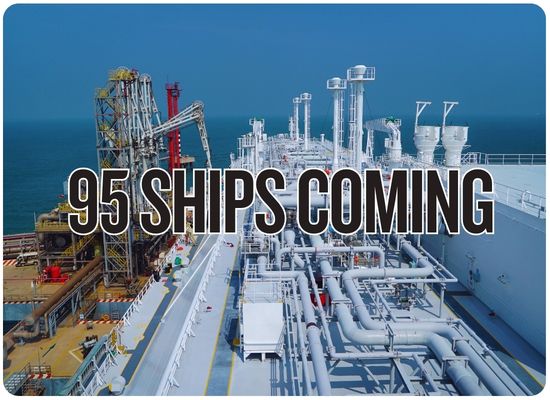

LNG shipping has gone from March panic rates near $300,000 a day to Atlantic freight near $25,000. Another wave of new ships is about to hit the water. For companies that can choose when to secure capacity, the most expensive decision may be locking too much freight too early.
The LNG carrier market is giving charterers a strange choice.
Hire a modern ship in the Atlantic spot market today and the freight can be around $25,000 per day. Ask the owner to guarantee that same class of vessel for three years and the current Baltic indication jumps to roughly $70,500 per day.
That spread is the market arguing with itself.
Prompt tonnage is abundant. Owners are competing for cargoes. Yet the forward market knows that an enormous wave of new LNG export capacity is scheduled to ramp up later this decade, and nobody wants to discover in 2028 that they saved money on freight but cannot find a ship.
Now add another number: approximately 95 new LNG carriers are expected to deliver in 2027.
For a charterer that does not absolutely need to lock multi-year freight today, waiting becomes a real financial option.
Do not interpret “95 deliveries” as “95 open ships.”
Many LNG carriers are built against specific liquefaction projects, portfolio requirements or long-term charter contracts. Others can be absorbed by new export projects as they start. Older steam vessels may leave the trading fleet. The 2027 delivery wave increases available capacity, but it does not add 95 identical ships to the spot position list on January 1.
The rate collapse has already happened
Waiting for 2027 is not a bet that today’s $300,000 market will finally break. It already broke.
Geopolitical disruption and the effective loss of Middle Eastern supply briefly transformed vessel economics.
Reuters-reported rate as increasing vessel availability and short-haul US-Europe trades weighed on freight.
Latest Baltic BLNG2 assessment despite a modest week-on-week recovery.
Longer eastbound employment still commands a substantial tonne-mile premium.
Atlantic rates have therefore fallen by more than 90% from the March extreme.
That does not mean owners are losing 90% of normal revenue. March was an exceptional geopolitical spike. But it demonstrates exactly why an LNG charterer should be careful about using one dramatic spot market to make a multi-year capacity decision.
The 2027 ship-supply wall is unusually large
The fleet is growing faster than normal just as the market is trying to absorb the 2026 wave.
| Delivery Period | New LNG Carriers | Market Effect |
|---|---|---|
| First 7 months of 2026 | ≈55 | Already contributed to greater vessel availability during 2026. |
| Rest of 2026 | ≈40–45 | Keeps supply pressure building into the start of 2027. |
| 2027 | ≈95 | Another very large delivery year. |
| 2028 | ≈80 | Fleet growth remains substantial even after the 2027 peak. |
Every delivery does not have to become open tonnage to pressure rates. A vessel delivered against a project can still free another vessel that was temporarily covering that project. New ships can trigger redeliveries, sublets and portfolio reshuffling throughout the fleet.
But the period market is refusing to price a collapse
This is probably the most important chart in the entire decision.
| Current Charter Exposure | Oct. 23, 2026 Rate | What Market Is Saying |
|---|---|---|
| Atlantic spot — USG/Europe | $25,400/day | Prompt tonnage loose |
| 6 months | $40,700/day | Owners obtain a premium for winter / near-term commitment. |
| 1 year | $51,800/day | Charterers pay substantially above spot for continuous availability. |
| 3 years | $70,500/day | The market expects future capacity to be worth more than today’s spot price. |
A three-year charter currently costs almost 2.8 times the Atlantic spot assessment.
That is why the right question is not: “Are LNG ships oversupplied today?”
They are.
The useful question is: will they still be sufficiently oversupplied in late 2027 to push three-year charter pricing below today’s $70,500?
What could waiting twelve months actually save?
Current three-year hire at $70,500/day equals approximately $77.2 million of nominal charter hire over 1,095 days, before considering fuel, port costs or other charterer expenses.
The calculation assumes the charterer does not need the vessel during the twelve-month waiting period. If capacity is required before then, the cost of bridging that year must be added.
Waiting for a three-year rate to fall from $70,500 to $50,000 would save roughly $22.4 million over the charter period. For a charterer with flexibility, the option to wait is therefore a multimillion-dollar commercial position—not simply a market opinion.
The first strategy: lock a three-year charter now
What you buy
Guaranteed access to modern LNG shipping capacity through 2029, insulating the cargo programme from a later rebound in rates or a sudden shortage of high-specification two-stroke ships.
What you risk
Paying $70,500/day through a period when incoming ships could push equivalent charters materially lower.
This strategy makes the most sense for a cargo owner that values certainty more than optionality.
If the vessel is required to service contracted LNG sales, a liquefaction project or a strategic energy-supply obligation, freight availability can matter more than catching the bottom of the rate cycle.
The second strategy: wait twelve months
This is the interesting trade for a charterer whose shipping requirement begins in late 2027 or can be covered flexibly until then.
The supply case
Roughly 95 ships are scheduled for delivery during 2027 after an already heavy 2026 delivery programme. More tonnage should expand the pool of ships competing for shorter and medium-term employment.
The owner’s problem
A vessel earning nothing still incurs crew, insurance, maintenance, class, financing and management costs. If enough ships become open, owners eventually have to compete on price.
The timing problem
Deliveries are spread across the year. Waiting until October 2027 may expose the charterer to a different market from waiting only until February.
The biggest risk
LNG export growth can absorb ships faster than deliveries loosen them, leaving the charterer facing a higher three-year rate next year.
The third strategy: buy the ship
Ownership solves access—but at a very different capital scale.
Recent 2026 LNG newbuilding contracts illustrate just how much money is involved.
A newbuilding ordered today does not solve a 2027 transportation need. Major LNG construction slots are already stretching into 2029 and beyond. For near-term capacity, “buy” generally means purchasing an existing or resale vessel—where price, charter status and availability are much more transaction-specific.
Ownership can make sense for an LNG producer or portfolio player with twenty years of cargo visibility. It is far less obvious for a company trying to solve a three-year transportation requirement.
Three years of charter hire versus $225M-plus of ship
At $70,500/day, three years of nominal hire totals about $77.2 million.
That is roughly one-third of the capital price of recent large LNG newbuilding contracts.
But this is not a simple rent-versus-buy ratio.
At the end of a time charter, the charterer has no vessel asset. An owner still owns a valuable LNG carrier. Conversely, the owner must fund equity, debt, crew, insurance, maintenance, class, drydock, technical management and residual-value risk. A three-year charterer hands those risks back with the ship.
The strongest argument against waiting: LNG exports are also surging
Vessel supply is only one half of the equation.
The IEA’s October 2026 LNG capacity tracker says more than 330 bcm per year of new liquefaction capacity is expected to come online between 2025 and 2030 from projects already under construction at the start of 2025.
Major projects with 2027 start dates include:
EIA currently expects U.S. LNG exports to rise by another 9% in 2027 after rapid 2026 growth.
That matters because new US production is especially shipping-intensive if Asian buyers pull cargoes across the Pacific rather than Europe taking short-haul Atlantic volumes.
The destination of one cargo can change the fleet balance
A US cargo sent to northwest Europe does not consume the same number of vessel-days as the same cargo sailing to Japan, Korea or China.
More US LNG to Europe
Shorter voyages return the vessel to the Atlantic position list more quickly. That increases effective ship supply and pressures freight.
More US LNG to Asia
Long voyages dramatically increase tonne-mile demand and can absorb many more ships even without a large increase in cargo volume.
Reuters specifically identified the recent concentration of US cargoes into Europe as one reason Atlantic freight collapsed despite strong LNG demand.
This makes the JKM-versus-TTF spread one of the most important indicators for anyone considering whether to wait for 2027 charter capacity.
There is already evidence of real oversupply
This is not simply an analyst forecast based on shipyard orderbooks.
Seapeak told investors in its 2026 filings that LNG project delays have caused a near-term oversupply of LNG carriers and warned that some vessels may face periods without charter coverage or recharter at lower rates.
The company also has LNG carriers on short-term employment and additional vessels scheduled to come off long-term contracts before mid-2027.
Wood Mackenzie has separately estimated that the number of low-utilisation LNG carriers could exceed 200 by 2030.
“Low utilisation” does not mean laid-up or commercially worthless. It means there may be materially more vessel capacity than the cargo programme requires—a condition that generally shifts negotiating power toward charterers.
Old steam ships are the market’s pressure-release valve
The 95-vessel delivery number is gross supply. Net fleet growth can be smaller.
Older steam-turbine LNG carriers consume materially more fuel than modern two-stroke ME-GI and X-DF vessels, and weak freight markets make those economics increasingly difficult.
Recycling has already accelerated. More than 20 LNG carriers had reportedly been sold for demolition since the fourth quarter of 2024 by early 2026, and owners continue preparing older steam units for sale as legacy charters expire.
This is why the modern-vessel market can tighten before the fleet number does.
A charterer needing an efficient 174,000-m³ two-stroke ship cannot necessarily substitute a 20-plus-year-old steam vessel. The overall fleet can look oversupplied while the premium modern fleet becomes balanced.
Clarksons is already warning that 2027 may strengthen—not weaken
This is the counterargument that prevents the waiting thesis from becoming too comfortable.
Clarksons Research’s October LNG market outlook says the carrier market is on course to gradually strengthen across 2027–28 as record LNG export projects start up and longer-haul Asian flows increase tonne-mile demand.
The same year that delivers roughly 95 new ships could also begin the demand wave that absorbs them.
That is exactly why current three-year pricing remains far above spot. Owners—and some charterers—believe today’s surplus could be temporary.
Middle East disruption makes the forecast even less clean
Before the 2026 Middle East conflict, the industry expected a huge LNG supply wave to begin easing gas markets.
Damage and disruption to Qatari facilities changed the timeline.
The IEA says the effect of the conflict is concentrated heavily in 2026 and 2027, delaying part of the expected global LNG supply expansion.
That cuts both ways for shipping.
Less LNG cargo supply
Fewer cargoes can reduce the number of ships required—negative for freight.
More disrupted trade patterns
Cargoes sourced from farther-away exporters can lengthen voyages and increase vessel demand—positive for freight.
Buy now vs 3-year charter vs wait twelve months
Buy
Best fit for a company with long-duration LNG shipping demand and appetite for asset, financing and residual-value risk.
- $225M-plus capital scale for modern newbuilds.
- New orders generally do not solve 2027 capacity.
- Owner keeps the residual vessel value.
- Owner absorbs OPEX, drydock and technical risk.
- Best economics require a long holding period.
Charter 3 Years Now
Best fit where guaranteed tonnage access matters more than potentially catching a lower 2027 rate.
- Current benchmark around $70,500/day.
- ≈$77.2M nominal three-year hire.
- Eliminates future availability risk.
- No residual vessel-value exposure.
- Could look expensive if 2027 period rates fall sharply.
Wait 12 Months
Best fit where the shipping programme can tolerate uncertainty and capacity is not absolutely required today.
- Lets much of the 2027 delivery wave enter the market.
- Could save $10M–$25M+ on a three-year fixture.
- Preserves bargaining leverage.
- Risks export growth absorbing surplus ships first.
- Dangerous if the cargo programme cannot tolerate being short tonnage.
The charterer who needs capacity today has a fourth option
Instead of choosing between “three years now” and “nothing for twelve months,” a charterer can bridge the market.
The current one-year Baltic indication is approximately $51,800/day, equivalent to about $18.9 million of nominal annual hire.
Fix one year now, enter the 2027 market when significantly more ships have delivered, then negotiate the longer charter.
This costs more than simply waiting if no capacity is needed today. But for a business that must move LNG now, it can preserve much more forward optionality than committing immediately to three or five years.
Twelve things to watch before deciding to wait
Six reasons waiting could backfire
Could waiting a year pay off?
Yes—particularly for a charterer whose real shipping requirement begins in late 2027 and who is not forced to secure capacity today.
Roughly 95 LNG carriers are scheduled to enter service during 2027 after an already enormous 2026 delivery programme. Atlantic spot freight is currently near $25,000/day, owners are still competing for cargoes, and public LNG shipowners are acknowledging near-term oversupply caused partly by project delays.
Against that background, committing today to approximately $70,500/day for three years means paying roughly $77 million for certainty.
If the three-year market falls to $50,000 next year, waiting would be worth roughly $22 million over a three-year fixture.
But the market is not offering that saving for free.
New US LNG projects are beginning an historic export buildout. Longer-haul Asian trading can consume enormous amounts of vessel capacity. Aging steam ships are leaving the fleet. Clarksons currently expects LNG shipping to strengthen through 2027–28 as new export capacity starts.
The practical conclusion is therefore narrower than “wait because ships are coming.”
If your cargo programme has flexibility, preserve it. A one-year charter, short-term coverage or delayed three-year decision may have unusually high option value heading into the largest LNG carrier delivery wave in years.
If missing a ship would jeopardize committed LNG sales, paying the period premium may still be cheap insurance.
Research basis
[1] Reuters — October 7, 2026. Approximately 55 LNG carriers delivered during the first seven months of 2026, another 40–45 expected by year-end, about 95 projected for 2027 and around 80 for 2028; Atlantic spot-rate decline from March peak.
[2] Baltic Exchange — Gas Report, Week 43, October 23, 2026. BLNG1 $32,800/day, BLNG2 $25,400/day, BLNG3 $58,900/day; six-month $40,700/day, one-year $51,800/day, three-year $70,500/day.
[3] IEA Global LNG Capacity Tracker — October 2026. More than 330 bcm/year of export capacity additions during 2025–2030, including multiple major U.S. projects scheduled for start-up in 2027.
[4] U.S. Energy Information Administration. U.S. LNG exports increased sharply during 2026 and are forecast to rise further in 2027 as Golden Pass, Port Arthur, Rio Grande and other projects ramp up.
[5] Clarksons Research — LNG Carrier Market Outlook, October 15, 2026. Soft early-October freight but forecast gradual strengthening in 2027–28 as record export projects start and long-haul LNG flows expand.
[6] Seapeak 2026 financial filings. LNG project delays have created near-term carrier oversupply; vessels face risk of idle periods or lower-rate rechartering.
[7] ADNOC L&S, COSCO Shipping Energy and Seapeak 2026 newbuilding disclosures. Current 174,000–175,000 m³ LNG carrier projects illustrate roughly $220M–$250M+ capital requirements and delivery schedules extending into 2029–2030.
[8] Wood Mackenzie / current LNG shipping-market reporting. Potential for more than 200 low-utilisation LNG carriers toward 2030 as fleet growth and liquefaction timing diverge.
LNG Charter Timing Calculator
Compare locking a three-year LNG carrier today with waiting for a lower period rate. Enter your own rate assumptions rather than treating the default values as a forecast.