
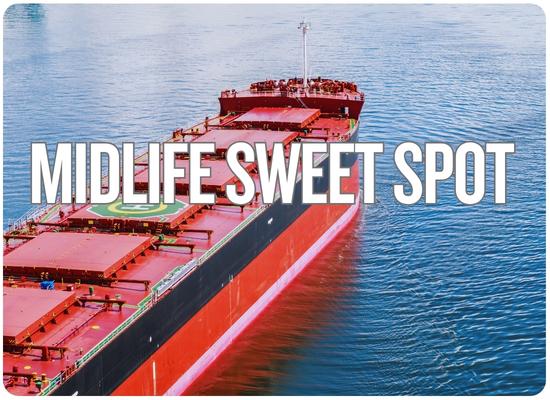

Is a 10-Year-Old Ultramax the Sweet Spot Right Now?
Five-year-old Ultramaxes now cost more than some newbuildings. Fifteen-year-old ships are cheaper but carry heavier survey, financing and efficiency risk. Sitting between them is the ship the market seems to want most: the ten-year-old Ultramax.
The most expensive Ultramax may not be the best Ultramax. The cheapest one probably isn’t either.
That sounds obvious until today’s market is laid out by age. A modern five-year-old Ultramax is currently being assessed around $39 million—about $3 million more than an indicative Chinese-built newbuilding that will not arrive until roughly 2029. Move down to ten years of age and the price falls to about $30.5 million.
That is an $8.5 million reduction for five additional years of age, while the vessel can still be an eco-era design, still has meaningful conventional trading life ahead of it and can start earning immediately.
Go another five years older and the headline price drops by roughly another $8.5 million—but now class, financing, steel, machinery, environmental efficiency and eventual resale begin carrying much more weight.
That is why ten years deserves a much harder look than the phrase “midlife ship” suggests.
The answer depends heavily on one line in the class status.
A ten-year-old Ultramax that has just completed its second Special Survey can be a completely different acquisition from an otherwise identical ship with Special Survey and drydock due shortly after delivery. IACS class-renewal surveys operate on five-year intervals. The age bracket may be the sweet spot; the wrong survey position can erase it.
Start with today’s age curve
The prices tell you exactly where buyers are paying for youth—and where the discount begins.
Indicative Chinese-built Tier III Ultramax with delivery around 2029. Cheapest modern hardware in the comparison—but unavailable today.
Prompt eco tonnage trades above newbuild because the vessel can capture today’s earnings immediately.
Roughly $8.5M below the five-year benchmark while retaining substantial remaining trading and resale runway.
Much lower entry cost, but financing, survey, efficiency and exit risk begin rising sharply. Current figure is an indicative extrapolation.
A five-year-old ship costing more than a newbuilding is not normal depreciation. It is a prompt-delivery premium. MSI reported this spring that five-year-old Ultramaxes had moved to roughly a 4% premium over newbuilding values—the first such inversion in the Handymax family since 2010.
The 10-year ship buys a lot of discount without buying extreme age
That is the basic sweet-spot argument.
| Age | Indicative Value | Difference vs 5-Year | Prompt Earnings | Survey / Technical Exposure | Financing Profile |
|---|---|---|---|---|---|
| Newbuild | $36.0M | $3.0M cheaper | Wait to 2029 | Lowest | Strongest |
| 5 years | $39.0M | Baseline | Immediate | Generally Low | Strong |
| 10 years | $30.5M | −$8.5M | Immediate | Survey Status Critical | Still Financeable |
| 15 years | $22.0M* | −$17.0M | Immediate | Higher | More Selective |
The 10-year ship is roughly 22% cheaper than the five-year-old at the current indicative prices.
The 15-year ship saves another roughly 28% versus the ten-year-old—but those second five years are where the buyer starts giving up more than age alone.
The earnings-to-price math favors midlife tonnage
Same freight market. Very different amount of capital tied up.
Current market intelligence puts a one-year Ultramax time charter around $19,500/day. Using that simply as an earnings benchmark—not as a guaranteed rate—shows why buyers keep competing for ten-year ships.
This is deliberately simple. It ignores OPEX, off-hire, commissions, finance, taxes, surveys and residual value. Its purpose is to show how much capital must be deployed against the same freight environment.
Despite the rally in 10-year-old asset values, Affinity’s September analysis says their earnings-to-value ratios remain below the long-term average—meaning midlife tonnage still screens relatively attractively against current earnings even after this year’s appreciation.
The newbuild is cheaper—but you cannot earn with it yet
This is the reason five-year-old ships can trade above newbuilding cost without the market having completely lost its mind.
Current Ultramax newbuilding indications are around $36 million for a Chinese-built 63,000-dwt Tier III vessel, but the market is looking at roughly 2029 delivery.
At a hypothetical $19,500/day for 30 months, a vessel already on the water has access to almost $17.8 million of gross time-charter revenue before that newbuilding is even delivered.
Do not compare $36M with $30.5M as if both ships are on the dock today.
Newbuilding payments are normally staged, and the newer ship should have better efficiency, lower maintenance exposure and a longer future life. But the wait has economic value. A buyer wanting employment in 2026 cannot substitute a 2029 ship for a prompt ten-year-old without separately pricing the missing three years of earning opportunity.
The 5-year-old may be the best ship—but not the best deal
Today’s market is charging heavily for youth.
What the extra $8.5M buys
Five more years of asset life, newer machinery, normally stronger fuel efficiency, easier financing, lower near-term maintenance risk and a longer resale runway.
What the buyer is paying for today
The five-year benchmark is above the current newbuild indication. A meaningful portion of that value is simply the privilege of owning an efficient modern ship immediately.
That price becomes especially important because MSI has already warned about the residual-value assumptions embedded in modern Ultramax deals. One recent MSI model illustrated that a five-year-old bought around $38 million would need to be sold five years later at roughly $39 million at age ten to generate a 10% equity IRR under that model’s assumptions.
That is an extraordinary reminder that buying the youngest secondhand ship at the top of an asset cycle can make the investment depend heavily on the next buyer also paying an elevated price.
The 10-year ship still has one major trap: Special Survey
Classification Special Surveys are carried out at five-year intervals. A ten-year-old ship therefore sits around its second major class-renewal cycle.
SS/DD just passed
Buyer gets the discounted midlife price with close to a fresh five-year class runway. This is the version of the ten-year Ultramax that makes the strongest sweet-spot case.
Survey due in 12–24 months
Still potentially attractive, but the next drydock and class project belongs directly in the acquisition model.
SS/DD due immediately
The apparent $8.5M discount to younger tonnage can shrink quickly if steel, cranes, machinery, ballast systems and off-hire all land shortly after delivery.
A 2016-built Japanese Ultramax at $30 million with freshly completed Special Survey can deserve a very different valuation from a $28 million sister whose survey is imminent. The cheaper ship may have the higher effective acquisition cost.
Actual 2016 sales show how wide the spread can be
Publicly reported transactions this summer included a 2016-built 63,590-dwt Ultramax sold around $31 million, while another same-year unit of similar size changed hands for a little above $26 million.
That $4 million-plus spread is a useful warning against treating “ten-year-old Ultramax” as one homogeneous asset.
Yard matters
Japanese construction, recognized designs and well-regarded engine packages can command material premiums.
Survey status matters
Drydock passed versus due can move the effective economics by millions.
Cranes and grabs matter
Geared bulkers earn their flexibility partly through cargo-handling equipment. Crane condition and grab packages affect both employment and future repair cost.
Efficiency matters
An efficient electronic-engine eco design can trade more like a younger asset than a conventional ship of exactly the same calendar age.
Ten-year tonnage sits on the useful side of the financing divide
Ship-finance terms vary enormously by sponsor, bank, employment, jurisdiction and collateral quality, so there is no universal age cutoff. But age clearly influences bankability.
Easy collateral story
Modern eco specification, long remaining life and high resale liquidity normally make this the most straightforward secondhand age bracket to finance.
Still inside the core lending window
Specialist ship lenders frequently describe vessels around ten years old as desirable collateral. Leverage may be lower than for newbuild or near-new tonnage, but the ship still offers meaningful loan maturity and resale runway.
The lender pool starts narrowing
More conservative LTVs, shorter amortization and stronger sponsor requirements become increasingly relevant. Some lenders simply prefer not to begin a new loan on tonnage in this age range.
One specialist marine financier publicly says assets are ideally no more than ten years old, while vessels up to 15–18 years can still be considered for stronger borrowers. Current market intelligence similarly shows age-adjusted lending becoming materially more conservative for 10–15-year ships and much more difficult beyond 15 years.
Environmental rules make specification more important than birthday
The IMO’s EEXI and CII requirements already apply to existing ships. CII rates vessels from A through E, and a vessel rated D for three consecutive years or E for one year must develop corrective actions.
A ten-year-old ship built during the transition into modern eco designs may have a surprisingly strong position here. Market commentary notes that many ships in the 10-year bracket are eco-designed and fitted with electronic main engines that reduce fuel consumption relative to older conventional tonnage.
| Age | Typical Efficiency Position | CII / EEXI Risk | Buyer Focus |
|---|---|---|---|
| Newbuild | Newest design / Tier III | Lowest | Future-proofing, fuel choice, 2029 regulations and technology obsolescence. |
| 5 years | Modern eco | Low | Verify actual consumption and CII rather than assuming age guarantees efficiency. |
| 10 years | Often eco-era | Manageable / Vessel Specific | Main-engine design, EPL, propeller/hull condition, annual CII trend. |
| 15 years | More conventional designs | Higher | Speed restrictions, upgrade capex and future charterer preference. |
The 15-year-old wins the cash-yield contest—but takes more risk
If nothing mattered except current freight divided by purchase price, the 15-year-old ship would look best.
At a $22 million indicative value and the same $19,500/day earnings assumption, the headline gross revenue-to-price ratio is materially higher than it is for younger ships.
The discount compensates the buyer for a shorter resale runway, increasing survey and machinery exposure, narrower financing options, greater emissions sensitivity and the possibility that charterers or buyers become more selective as the vessel moves toward 20 years.
A cash buyer with strong technical management may love that trade. A leveraged owner planning a ten-year hold may view the same ship very differently.
Remaining life changes the exit problem
There is no universal fixed “economic life” for an Ultramax. Ships can trade beyond 25 years if condition, regulations and economics allow. But a 25-year horizon is still useful as a simple acquisition stress test.
| Buy Today | Age After 5 Years | Age After 10 Years | Exit Flexibility |
|---|---|---|---|
| Newbuild | 5 | 10 | Highest |
| 5-year-old | 10 | 15 | Strong |
| 10-year-old | 15 | 20 | Still meaningful |
| 15-year-old | 20 | 25 | Much narrower |
This is one of the strongest arguments for the 10-year vessel. A five-year investment horizon takes the ship to roughly 15—not 20. That still leaves a reasonably broad resale audience if the vessel remains efficient, well-maintained and survey-current.
The current market itself is voting for midlife ships
This is not a theoretical preference.
Affinity says dry-bulk asset values are up about 13% overall during 2026, while Ultramax values have risen about 19%. Ten-year-old vessels across the market were among the strongest performers, rising about 18%.
Earlier in the year, Xclusiv reported ten-year Ultramax values up roughly 18% year-on-year, and later market analysis continued to highlight disproportionate buying interest in vessels around the 10-year age bracket.
The Supramax/Ultramax segment is also highly liquid. Current market commentary has described it as one of the busiest S&P sectors because geared ships can work a wide variety of grain, minor-bulk, coal, fertilizer and regional trades.
But today’s prices are not historically cheap
“Relative value” is not the same thing as “cheap.”
Public-company market data earlier in 2026 put a ten-year Ultramax around $27 million versus a 2015–2025 historical average near $21 million. Another SEC filing put the 2015–2025 average for a ten-year Supramax/Ultramax benchmark at only about $16 million, depending on benchmark basis and specification.
Today’s roughly $30.5 million market therefore sits high in historical terms.
A 10-year Ultramax is not compelling because $30.5 million is cheap historically. It is compelling because the ship can be substantially cheaper than today’s five-year tonnage while preserving enough efficiency, financing access, trading life and resale optionality to remain a mainstream asset.
The perfect 10-year acquisition would look something like this
Six reasons a “cheap” 10-year ship may not be the sweet spot
So is 10 years the sweet spot?
In the current Ultramax market, it may be the most interesting age bracket.
The buyer avoids today’s remarkable premium for five-year-old tonnage, saves roughly $8.5 million at current benchmark levels, gains immediate earning capability that a 2029 newbuild cannot provide, and still owns a vessel young enough to retain mainstream finance, chartering and resale options.
The 15-year-old ship provides more immediate cash yield, but the discount comes with a shorter exit runway and greater technical, regulatory and financing risk. The newbuild provides the strongest long-term asset but requires waiting through today’s earning market. The five-year-old is arguably the best physical ship—but today’s buyer is paying a scarcity premium for it.
The strongest 10-year acquisition is therefore not simply a ship built in 2016.
It is a well-built, efficient Ultramax with Special Survey behind it, clean technical records, good cranes, functioning BWMS, acceptable CII and enough financing and resale runway left to behave more like a modern asset than an old one.
Find that ship near the $30 million range and today’s age curve starts looking very interesting indeed.
Research basis
[1] Affinity Shipping — Dry Asset Values Reviewed, September 29, 2026. Dry-bulk values +13% in 2026, Ultramax +19%, particularly strong 10-year-old values, and earnings-to-value analysis.
[2] AXIA Shipping Intelligence — Week 42, October 12–16, 2026. Ultramax 63k indications of approximately $36.0M newbuild, $39.0M five-year, $30.5M ten-year and estimated $22.0M fifteen-year; 1-year TC $19,500/day and 3-year $17,000/day.
[3] Maritime Strategies International / HORIZON reporting. Five-year Ultramax values above newbuilding prices, strong prompt-delivery premium and limited yard availability until 2029.
[4] Xclusiv / current S&P reporting. 2016-built Ultramax sales, age-curve appreciation and strong buyer interest in midlife dry-bulk tonnage.
[5] Pacific Basin / Clarksons Research. Long-term Ultramax newbuilding and ten-year eco secondhand value history.
[6] IACS hull-survey requirements. Five-year Special Survey / Class Renewal schedule.
[7] IMO — EEXI and CII framework. Existing-ship energy-efficiency requirements and annual A–E operational carbon-intensity ratings.
[8] Current specialist ship-finance market guidance. Age-related lending preferences, reduced leverage on older tonnage and stronger appetite for efficient, liquid assets.
Ultramax Age-Value Comparator
Compare a five-, ten- or fifteen-year Ultramax using purchase price, earnings, operating cost and immediate survey exposure. This is a screening model—not a vessel valuation or full DCF.