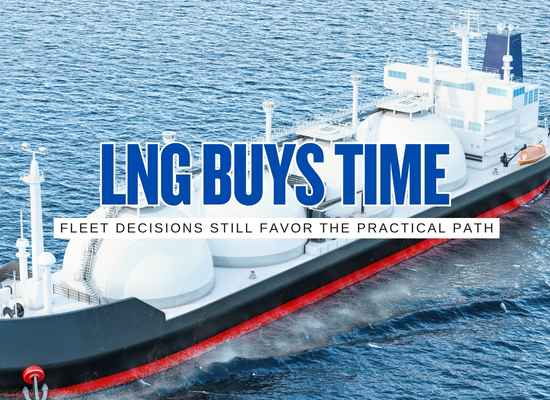

Shipowners did not give LNG extra runway because the debate disappeared. They gave it more runway because the practical alternatives still face harder constraints in real fleet decisions. Through 2025 and into 2026, LNG kept showing up where capital, infrastructure, and compliance pressure met actual operating needs. The orderbook stayed heavy, especially in containers. Bunkering availability kept widening. FuelEU Maritime started making near-term carbon intensity a live commercial issue at EU ports. The IMO’s net-zero framework also moved the industry further toward lifecycle fuel accounting, which matters because methane as well as CO2 now sits more directly inside the regulatory conversation. At the same time, critics were not wrong to keep pressing on methane slip, upstream emissions, and long-term fossil lock-in. That is exactly why LNG’s current advantage is best understood as time, not certainty. It is buying time because it is scalable, financeable, and usable now, while methanol, ammonia, and e-fuels still face bigger supply, cost, and infrastructure gaps in many real-world trades.
The real story is not that LNG won the long game. The real story is that it kept winning the next decision.
The market kept picking the available path
LNG kept its footing because it solved more current problems at the same time than most rival fuels. It offered a mature engine ecosystem, expanding bunkering, workable energy density for long-haul shipping, and a clearer financing story than fuels still waiting on broader production and delivery networks. That mattered even more once carbon compliance started to become a direct cost line instead of a distant policy discussion.
Where LNG still looks commercially credible
| Segment | Why LNG still fits | Main caution | Current read |
|---|---|---|---|
| Containerships | Scale, schedule reliability, long-haul energy density, major liner willingness to commit | Methane accounting and long-term policy tightening | Strong near-term fit |
| Car carriers and RoRo | Predictable corridors, branding value, manageable bunker planning | Future fuel-switch economics remain uncertain | Good transitional fit |
| Cruise | Local air-quality gains and strong public-facing compliance case | Methane slip criticism is especially visible here | Operationally useful, reputationally contested |
| Tankers and gas carriers | Familiar gas handling environment and strong technical comfort | Trade-specific bunker economics can swing | Selective strength |
| Bulkers | Some owners like the bridge option while waiting for broader fuel clarity | Route diversity makes bunkering strategy harder | Case by case |
Critics still have real ammunition
LNG’s strongest commercial case exists alongside a real climate accounting challenge. If methane slip is higher than assumed, a large part of LNG’s emissions benefit weakens. That is not a side issue anymore. It is central.
There is also a capital risk argument. Owners could build an LNG-capable fleet only to face stricter lifecycle accounting, tighter methane treatment, and stronger pressure to source scarce low-carbon methane later. In that scenario, LNG still buys time, but the cost of extending that time could rise.
The honest reading is this: LNG has become harder to dismiss commercially, while becoming harder to defend casually from a climate standpoint.
The next decision window
Fuel transition runway tool
This quick calculator estimates whether LNG is likely to buy a vessel owner meaningful time, selective time, or too little time based on current operating conditions.