
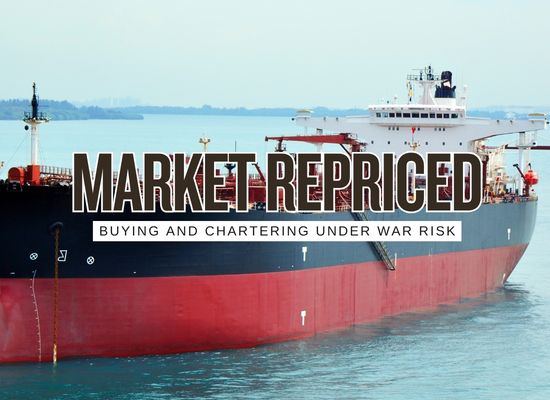

The Gulf war is not just pushing up “risk.” It is changing the ship market’s plumbing: which vessels are considered tradable, which charters can be executed without last minute insurance surprises, how long ships sit idle waiting for passage, and how buyers price time, compliance, and cash conversion when the Strait of Hormuz is constrained.
Ship Market Report
Buying Selling Chartering Under Gulf War Conditions
A decision-grade view of freight, asset pricing, insurance, and deal structure when Hormuz risk and Gulf disruption dominate the tape.
The market is repricing three things first
In this cycle, the biggest moves come from time at sea, usable tonnage, and war risk economics. If you track these three, you usually understand the next week of fixtures and deals.
12 market shifts showing up in real time
These are the behaviors that tend to repeat when Gulf conflict escalates. Each one includes the commercial impact across chartering and S&P.
1️⃣ “Open position” becomes a tradable asset
Ships already outside the highest-risk box get bid up because they can move cargo now. This creates sharp premiums for prompt tonnage even when the broader market looks uncertain.
Deal desk signal
Charterers ask fewer questions about rate first and more questions about certainty of movement and insurance placement.
2️⃣ War risk premium turns into voyage math
Additional premium can be large enough to change whether a voyage makes sense. The rate is no longer “the rate.” The rate becomes rate minus premium, minus delay, minus friction.
Practical consequence
Owners demand clearer pass-through language. Charterers demand clearer refusal and deviation language.
3️⃣ Tankers can be insurable and still stay away
Even when war risk cover is technically available, operators may avoid the transit if the threat level and incident pattern make the probability-weighted downside unacceptable.
4️⃣ The usable fleet shrinks faster than the fleet
Vetting, compliance screening, and insurer appetite filter ships out. That is how you get a two-tier market where “clean ships” trade like scarce inventory.
5️⃣ Safety and navigation interference becomes commercial
When GNSS interference and AIS anomalies rise, owners price in additional operational risk and slower transits, and charter parties start reflecting that reality.
6️⃣ LNG and gas logistics react sharply to disruption
Gas cargoes have high value and tight schedules. A disruption can trap ships, force diversions, and push charterers to compete for reliable tonnage.
7️⃣ Containers feel the shock through costs and schedule padding
Carriers face higher fuel, insurance and storage costs and tend to pass them through via surcharges. Reliability becomes a paid feature.
8️⃣ S&P buyers pay for “paper cleanliness”
In conflict, paperwork and compliance become speed. Buyers get aggressive for ships with clear ownership, strong records, and predictable survey arcs because those ships can trade under more counterparties.
9️⃣ Older tonnage is priced on survey math, not optimism
If the ship needs time or capex, the discount widens because the timeline is expensive during disrupted markets.
🔟 Deal structure becomes as important as headline price
Holdbacks, conditions precedent, and clearly bounded cure lists win. Vague “price chips” create disputes when the risk is moving daily.
1️⃣1️⃣ Liquidity premiums and penalties widen
Modern, charter-ready ships can hold value. Ships with unclear records, unclear trading history, or heavy upcoming work can become hard to finance or insure, and buyers demand bigger discounts.
1️⃣2️⃣ Humanitarian constraints become operational constraints
When large numbers of ships and crews are stranded, it tightens effective supply, complicates crew changes, and slows normal trading patterns.
Chartering playbook changes that matter most
The fastest charter wins in this environment usually come from pricing the friction explicitly and writing the clauses so time and premium do not become a surprise loss later.
Buying and selling behavior that repeats during Gulf crises
S&P does not stop. It re-sorts. Buyers either pay up for clean, charter-ready ships, or demand protection for uncertainty through holdbacks and conditions.
What buyers chase first
- Clean profile ships that clear vetting and insurance faster
- Mid-age tonnage with a visible survey arc and bounded capex risk
- Ships positioned outside the risk box that can earn immediately
What gets discounted hardest
- Unclear records that slow screening
- Heavy survey exposure that competes with urgent trading windows
- Anything that creates closing delay risk when the market is repricing daily
War Risk Cost and Delay Tool
Convert extra days plus war additional premium into a single directional cost figure for voyage planning, charter negotiation, and deal underwriting.
Bottom-Line Effect
Under Gulf war conditions, the ship market is priced around access and friction. Access means you can insure, clear screening, and move.
Friction means extra days, higher premiums, and operational constraints that turn headline rates into smaller realized earnings.
The deals that hold up best are the ones that write those costs into the structure instead of discovering them later.

tadalafil benefits bodybuilding
tadalafil benefits bodybuilding
vidalista 80 mg black
vidalista 80 mg black
cenforce 100 for sale
cenforce 100 for sale
cyclosporine drug classification
cyclosporine drug classification
viagra sildenafil price
viagra sildenafil price
domperidone medication
domperidone medication
semaglutide tabletten bijwerkingen
semaglutide tabletten bijwerkingen
acyclovir injection cost
acyclovir injection cost
xenical australia reddit
xenical australia reddit
terbinafine antifungal treatment
terbinafine antifungal treatment
terbinafine mechanism expert overview
terbinafine mechanism expert overview
sildenafil pharmacokinetics and food
sildenafil pharmacokinetics and food
sildenafil form‑based pricing
sildenafil form‑based pricing
penile deformity contraindications
penile deformity contraindications
vardenafil grapefruit warning
vardenafil grapefruit warning
avanafil price impact factors
avanafil price impact factors
vardenafil cautionary summary
vardenafil cautionary summary
medical review approval
medical review approval
Duration & Half-Life Reference
Duration & Half-Life Reference
Sildenafil vs Avanafil Mechanistic Overview
Sildenafil vs Avanafil Mechanistic Overview
Sildenafil vs Cialis Duration Guide
Sildenafil vs Cialis Duration Guide
this tadalafil reference
this tadalafil reference
tadalafil drug interactions
tadalafil drug interactions
comparing metronidazole formulations
comparing metronidazole formulations