Charterers are paying for more than deadweight right now. In several shipping markets, the real premium is landing on ships that are prompt, commercially clean, technically ready, and flexible enough to absorb route disruption, shifting cargo programs, and volatile timing. Recent tanker-market reporting shows tight tonnage still supporting rates in parts of the market, one-year time-charter rates rising alongside secondhand values, and public owners actively mixing vessel sales with long charter cover instead of relying on one simple playbook. That combination points to the same conclusion: optionality itself has become something charterers are willing to pay for.
Chartering Report 2026
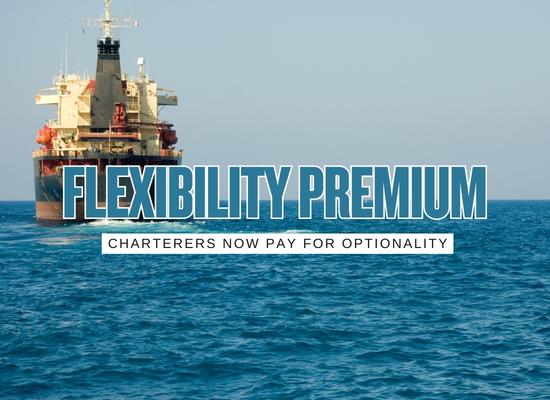
The Flexibility Premium in Ship Chartering
1️⃣0️⃣ reasons charterers are paying up for optionality, not just tonnage
Market Backdrop
The shipping market is rewarding flexibility in a more visible way than usual. Tanker rates remain firm by historical standards, prompt positions can still swing rate direction quickly, one-year time-charter rates have been rising with secondhand asset values, and some owners are actively locking long cover on selected ships while selling others. That is a strong sign that commercial flexibility is being priced directly.
| Live signal |
Why it points to optionality |
Commercial read |
| Tight tonnage in key pockets |
When lists tighten, prompt and usable ships gain leverage |
Availability becomes part of the price |
| Prompt lists can change rates fast |
Rates can drop or spike quickly when open ships suddenly grow or disappear |
Timing flexibility carries value |
| 1-year TC rates and asset values rising together |
Charter visibility is supporting valuation and confidence |
Charterability is now part of asset quality |
| Owners mixing sales and charter-outs |
The market is rewarding selective flexibility, not one fixed strategy |
Optionality is a monetizable advantage |
Operating View
A flexible ship gives the charterer more than transport capacity. It gives cleaner scheduling, better response to disruption, fewer commercial dead ends, and a higher chance of actually capturing the intended voyage economics.
1️⃣ Prompt position is winning a premium
The edge: A ship that is available in the right place at the right time is often worth more than a theoretically cheaper ship that is open too late or too far away.
Commercial read: In volatile markets, timing can erase apparent savings very quickly. If cargo windows are narrow or the market is tightening, charterers often pay more to secure a prompt ship rather than gamble on repositioning risk or late availability. This is especially true when rate direction can change within days as lists open or tighten.
2️⃣ Clean charterability is separating ships faster
The edge: Ships that are commercially acceptable to a wider set of counterparties are more valuable than ships that create extra questions.
Commercial read: Charterers are paying for fewer headaches. A vessel with cleaner paperwork, acceptable operating history, clearer compliance posture, and fewer restrictions gives the charterer more freedom to place cargoes and finalize deals quickly. The premium is often not just about avoiding rejection. It is about preserving commercial options late in the process.
3️⃣ Route flexibility is more valuable in a disrupted map
The edge: Ships that can be redeployed across more lanes or trading patterns carry extra value when route assumptions are unstable.
Commercial read: Geopolitical friction, sanctions, insurance issues, delays, and changing voyage economics mean charterers are not only paying for transport. They are paying for fallback plans. A flexible ship gives them more ways to salvage commercial intent if the original route becomes less attractive or harder to execute.
Optionality premium shows up when
- Voyage assumptions may change after fixing
- Regional disruption alters the best route
- Insurance and delay exposure are moving around
- Charterers want backup deployment choices
4️⃣ Technical readiness is now a commercial weapon
The edge: Ships that are ready to trade cleanly without technical uncertainty can command better commercial attention.
Commercial read: Charterers are paying up to reduce execution risk. A vessel that does not carry looming technical doubt, awkward survey timing, or unclear maintenance posture is easier to fix and easier to defend internally. In a market moving quickly, confidence has value. A clean technical story can be the reason a ship wins the cargo even when another candidate looks slightly cheaper.
5️⃣ Period cover is rewarding reliability and flexibility together
The edge: Charterers seeking longer cover are not just booking steel. They are paying for dependable commercial utility over time.
Commercial read: When one-year TC rates rise together with asset values, the market is telling owners that reliable employment potential matters more than before. Charterers fixing period cover want ships that can stay useful across changing conditions, not just ships that look acceptable on day one. That makes broad charter appeal and operational consistency more valuable than simple capacity alone.
6️⃣ Fuel profile and efficiency still influence flexibility
The edge: A more efficient ship often gives the charterer more room to protect voyage economics if conditions change.
Commercial read: Optionality is not only about route choice. It is also about economic survivability. A ship with a better fuel profile can remain commercially workable across more cargoes, more distances, and more freight environments. That does not automatically mean the newest ship always wins. It means the charterer has more ways to make the math work.
7️⃣ Faster execution is worth money now
The edge: Ships that can move through approvals, checks, and fixing discussions quickly are more attractive in a fast market.
Commercial read: When rates can swing sharply as prompt tonnage expands or disappears, speed matters. Charterers value ships and counterparties that let them close without prolonged uncertainty. That means document readiness, operational credibility, and fewer last-minute issues can all support a premium even when the nominal freight number is not the lowest.
8️⃣ Older ships can still win if they offer usable flexibility
The edge: Age alone is not disqualifying when a ship can still deliver immediate utility and acceptable commercial performance.
Commercial read: Recent tanker commentary shows stronger one-year TC earnings helping push values higher even for overaged units. That does not erase the age penalty forever. It does show that when the market is paying for immediate cash generation and usable availability, charterers and buyers can temporarily value flexibility and readiness more than age alone.
9️⃣ Charterers are paying to avoid dead ends
The edge: The premium often comes from avoiding bad outcomes, not only from chasing better ones.
Commercial read: A more flexible ship reduces the chance that the charterer gets trapped by late changes, route friction, tighter lists, or counterparty discomfort. That has real monetary value. In practical terms, charterers are often paying more to preserve their downside rather than because they expect perfection.
🔟 The premium is becoming visible in fleet strategy too
The edge: Owners are monetizing flexibility in more than one way.
Commercial read: When owners sell selected ships, charter out others on longer cover, and still defend strong asset values, the market is showing that flexible commercial quality can be monetized through both earnings and sale proceeds. That is one reason the current market feels different. Optionality is no longer just a soft concept. It is showing up in fixing strategy, sale decisions, and valuation support.
Optionality Scorecard
A simple screen to estimate how much commercial flexibility a ship is really offering.
Bottom-Line Effect
In this market, the best ships are often not just the biggest or cheapest. They are the ones that give charterers more usable choices when timing, routes, costs, or risks change. That is why optionality is increasingly earning a real premium.
This report’s core point is that charterers are increasingly paying to reduce commercial regret, not just to secure carrying capacity. The evidence behind that view includes tight-tonnage pockets lifting rates, prompt availability quickly changing rate direction, one-year tanker time-charter rates moving up with secondhand prices, and owners such as Scorpio locking in long charter cover on some ships while monetizing others through sale. Those are all signs that flexibility, readiness, and broad commercial usefulness are carrying price.


stendra ed med
stendra ed med
what is avanafil
what is avanafil
finasteride effects reddit
finasteride effects reddit
is orlistat safe
is orlistat safe
semaglutida comprimido emagrece efeitos colaterais
semaglutida comprimido emagrece efeitos colaterais
doxycycline 100mg price in kenya
doxycycline 100mg price in kenya
bupropion starting dose for anxiety
bupropion starting dose for anxiety
minoxidil mechanism details
minoxidil mechanism details
minoxidil duration scientific overview
minoxidil duration scientific overview
online safety verification
online safety verification
amoxicillin antibiotic information
amoxicillin antibiotic information
sildenafil vs tadalafil
sildenafil vs tadalafil
this Indian tadalafil overview
this Indian tadalafil overview
this telehealth tadalafil guide
this telehealth tadalafil guide