
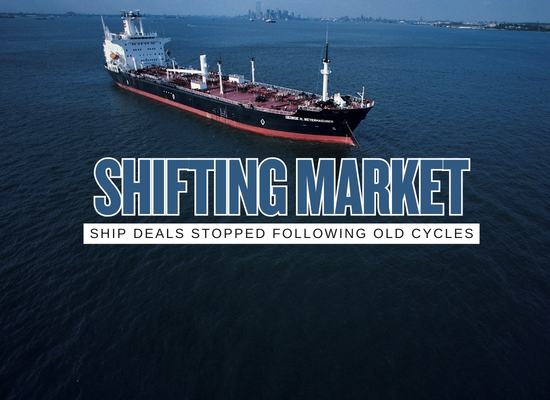

The old cycle logic has been getting stress-tested hard. In recent weeks, tanker charter rates have surged, secondhand tanker values have stayed very firm, and public owners have shown they are willing to sell some ships while fixing others on period cover instead of choosing one clean lane. Scorpio Tankers, for example, announced the sale of three product tankers while also chartering out two LR2s on multi-year deals, while CMB.TECH said higher charter rates have been accompanied by higher asset values and that secondhand VLCC and Suezmax prices are at their highest levels in 20 years. Market commentary from Signal also points to one-year time-charter rates and secondhand prices moving upward together, including for overaged units.
Ship Markets 2026
Buying Selling and Chartering in a Repriced Market
A field guide for owners, buyers, and chartering teams operating in a market where freight, asset values, and risk premiums are all moving together.
The Market Reset
The old pattern was easier to read. Weak freight often created buying windows. Strong freight often pushed owners toward selling. Chartering sat in its own lane, mostly about earnings visibility. Today, those lines are blurred. Freight strength is feeding asset values. Period cover is influencing sale expectations. Risk itself is affecting deployment, pricing, and buyer appetite.
Working View
This is no longer just a freight market. It is a freight market, an asset market, and a risk market stacked together. That is why broad rules are failing and ship-by-ship sorting is becoming more important.
1️⃣ Buying has become a quality-underwriting exercise
The shift: Buyers are no longer just comparing age, deadweight, and last-done sales. They are underwriting employability, fuel profile, paper quality, class posture, survey timing, and how quickly the ship can move into real revenue.
Owner takeaway: A ship that looks expensive on backward-looking comps can still be a good buy if it is commercially ready, broadly acceptable, and capable of stepping into attractive employment without delay. The reverse is also true. A ship that screens cheap on age or headline valuation can become expensive very quickly if the buyer inherits class ambiguity, heavy upcoming capex, weak charter appeal, or trading limitations. The smarter buying question now is not “is this below historical average?” It is “does this ship earn well enough, soon enough, and cleanly enough to justify the price in a market that can reprice again before the ink dries?”
Buy-side pressure points
- Next 24-month capex path
- Class and survey posture
- Fuel efficiency versus likely charter competition
- Document cleanliness and speed to closing
- Ability to secure acceptable employment without long idle time
2️⃣ Selling is now as much about fleet shape as price
The shift: Selling is no longer just a profit-taking decision. It is increasingly a fleet-quality decision, a leverage decision, and sometimes a timing decision around future technical drag.
Owner takeaway: The right sale today often comes from asking whether the ship is close to becoming less strategic inside the fleet. That can happen when major capex is approaching, when the vessel’s efficiency profile is slipping behind market preference, when charterers are likely to become more selective, or when management already knows the ship is not part of the long-term core. In that situation, selling into strength is not simply opportunistic. It is often the disciplined choice that protects fleet quality before the market starts drawing harsher lines between preferred and non-preferred tonnage. The strongest sellers in this market are usually not emptying the fleet. They are pruning deliberately.
Clean reasons to sell
- Upcoming technical spend changes the value case
- Sale proceeds can reduce debt or fund renewal
- The vessel is drifting outside the long-run fleet profile
- The current market is still rewarding short- and medium-term utility
3️⃣ Chartering is now feeding secondhand values
The shift: Period cover is no longer only about smoothing earnings. It is affecting how both owners and buyers think about asset value today.
Owner takeaway: A ship with credible charter appeal is carrying more than freight optionality. It is carrying valuation support. If a vessel can attract respectable period interest, the buyer is not only looking at steel and age. The buyer is looking at the possibility of bankable earnings, cleaner utilization, and a more defendable cash-flow profile. That changes sale and purchase behavior. It also changes hold decisions. A ship may be worth keeping because it can win good cover, and that same period appeal may strengthen the eventual resale story later. This is one of the biggest breaks from the older playbook. Charterability is no longer a separate commercial topic. It is now part of the asset itself.
Why charterability matters more now
- Supports buyer confidence on near-term earnings
- Improves financing and internal valuation comfort
- Makes hold decisions easier to defend at board level
- Can narrow the gap between owner expectation and buyer willingness
4️⃣ Older ships are staying relevant longer than many expected
The shift: Older tonnage is not being discounted as quickly as many owners would expect in a more conventional market, especially when strong cash generation is still supporting demand for available ships.
Owner takeaway: That does not mean age stopped mattering. It means age is being filtered through earnings power, availability, and commercial usefulness. An older ship with workable class posture, acceptable documentation, and realistic access to employment can still attract meaningful interest if the market is paying for immediate utility. That creates a very specific opportunity for sellers. A ship that may look vulnerable in a calmer market can sometimes be sold on much better terms during a period when buyers are still valuing short-run cash flow highly. The danger is overstaying the window. Once the freight backdrop cools or market selectivity hardens, the age discount can return fast and punish hesitation.
Questions older-tonnage owners should ask
- Is the ship still commercially acceptable to the right counterparties?
- How much survey or repair burden is sitting just ahead?
- Would this ship be harder to sell if rates normalized?
- Is today’s buyer appetite stronger than the ship’s likely future profile?
5️⃣ Geopolitics now sits inside the commercial model
The shift: Geopolitical risk is no longer just a route-planning issue. It is influencing freight strength, insurance cost, deployment choices, timing risk, and even the valuation premium attached to commercially flexible ships.
Owner takeaway: Buyers, owners, and charterers have to underwrite the ship and the trading environment around the ship at the same time. A vessel with broader trading acceptability, cleaner compliance posture, and stronger operational credibility may be worth more simply because it can keep moving through a messier market with fewer penalties. In practical terms, this means commercial flexibility has become more valuable. The vessel that can be employed across more lanes, placed more easily, and defended more cleanly in front of counterparties is carrying a stronger risk-adjusted value than a ship that looks similar on paper but is more exposed to friction. Risk is no longer just an outside market force. It has become part of the ship’s commercial profile.
Commercial effects of a riskier map
- Wider spread between headline rate and truly capturable rate
- More value placed on flexibility and acceptable trading history
- Greater importance of insurance, sanctions, and counterparty readiness
- Stronger premium for ships that can stay commercially usable in messy conditions
6️⃣ Speed and preparation are now real commercial edges
The shift: Markets are repricing quickly enough that slow internal approvals, weak documentation, or delayed charter calls can erase an advantage before a deal is closed.
Owner takeaway: This is becoming one of the most underappreciated differences in the current market. Buyers need financing, technical review, and decision authority lined up earlier because hesitation can mean paying more later or losing the target entirely. Sellers need cleaner title, cleaner class posture, cleaner proof packs, and a faster closing path because a good pricing window can narrow suddenly. Chartering teams need a more disciplined trigger for when to stay exposed and when to lock cover, because the market can move far enough in a week to change the logic materially. In older cycles, a slower process could sometimes be absorbed by a slower-moving market. In this one, preparedness itself is part of commercial performance.
The practical edge
- Pre-cleared documentation shortens negotiation drag
- Faster approvals preserve pricing opportunity
- Better data improves charter and sale timing calls
- Prepared counterparties can win before price becomes the deciding factor
Ship Sorting Matrix
The fastest way to avoid bad fleet-wide decisions is to sort ships by role, not by headline mood.
| Ship profile | Best lean | Why it fits | Main trap |
|---|---|---|---|
| Older ship with heavier capex ahead | Sell | Monetizes before technical drag grows | Waiting until buyers become more selective |
| Modern eco ship with wide charter appeal | Hold or charter out | Keeps earnings power and optionality alive | Ignoring a rare peak in asset pricing |
| Highly leveraged ship | Sell or partial monetization | Turns market strength into resilience | Giving up too much upside too cheaply |
| Ship with good period demand | Charter out | Locks earnings while preserving the asset | Fixing too early into a rising spot market |
| Non-core ship in a renewal plan | Sell | Improves fleet quality and capital allocation | Replacing it with overpriced tonnage |
Decision Screen
Directional tool to compare immediate sale value against a simple keep-and-earn scenario.
Bottom-Line Effect
The market has not stopped making sense. It is just working through more layers at once. Freight, asset values, charter cover, and risk are all feeding each other. The best operators are not forcing one answer across the fleet. They are sorting ships much more precisely into buy, sell, and charter buckets.

generic tadalafil reviews
generic tadalafil reviews
comprar vidalista online
comprar vidalista online
kamagra gelis kaunas
kamagra gelis kaunas
ozempic smelly breath
ozempic smelly breath
doxycycline hyclate used for bronchitis
doxycycline hyclate used for bronchitis
bupropion 200 mg er
bupropion 200 mg er
toradol pain relief medical guide
toradol pain relief medical guide
minoxidil essential faq
minoxidil essential faq
sildenafil safety assessment
sildenafil safety assessment
avanafil pde5 inhibition
avanafil pde5 inhibition
vardenafil duration behavior
vardenafil duration behavior
orlistat health warnings
orlistat health warnings
orlistat side effect science
orlistat side effect science
OnsetMaster Knowledge Base
OnsetMaster Knowledge Base
Duration Variability Educational Resource
Duration Variability Educational Resource
Sildenafil vs Avanafil Peak Analysis
Sildenafil vs Avanafil Peak Analysis
Brand vs Generic Availability
Brand vs Generic Availability
tadalafil and sildenafil for ED
tadalafil and sildenafil for ED
SemaGLP pharmacy information
SemaGLP pharmacy information
this antibiotic information site
this antibiotic information site