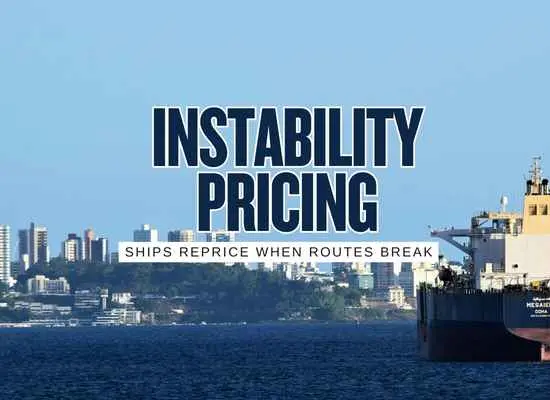

When geopolitics heat up, shipping does not just get “more expensive.” The whole market re-sorts itself: which routes pay, which ships are employable, which buyers can finance, and which owners can trade without friction. Here’s the instability playbook, listicle style, built around what actually moves freight, charters, and asset prices in 2026.
Ship Market Field Guide
Global Instability Edition
A list of the moves that reprice ships, charters, and deals when the world gets unpredictable.
The market flips on three levers
Instability changes shipping economics through a simple chain reaction. If you track these three levers, you will usually understand the move before the headline rate prints.
The cool listicle: 15 ways instability changes the ship market
Each item includes the real mechanism, the segment most exposed, and the deal level signal that shows up in fixtures and S&P.
1️⃣ Chokepoints turn into a “time tax” on global trade
When a chokepoint is risky, ships do not just detour. The entire supply chain pays a time tax: longer voyages, more ships tied up at sea, and slower container cycles.
What you will notice first
- Rerouting becomes the default schedule, not the exception
- Transit time assumptions in contracts quietly get revised
- Owners with the “right” open position get paid fast
2️⃣ War risk insurance becomes a market maker
In high risk zones, insurance is not a back office detail. Cancellation notices, exclusions, and surcharges can instantly remove ships from a lane, or make a cargo uneconomic.
Deal desk signal
If charterers start asking for tighter trading limits, additional cover confirmations, or broader owner warranties, premiums are moving even before freight indices catch up.
3️⃣ “Usable fleet” shrinks faster than the fleet
Instability creates a two tier market. A ship can be physically available but commercially unavailable due to vetting, compliance screens, or insurer appetite.
Who benefits
- Owners with strong inspection history and clean documentation
- Ships with charterer friendly specs and predictable maintenance arcs
- Operators who can show consistent AIS, voyage, and cargo records
4️⃣ Sanctions enforcement rewires routes and counterparties
When enforcement tightens, the trading map changes. Some barrels and cargoes still move, but the service stack changes: who can insure, finance, class, and manage the ship.
Fast filter
If a deal relies on “we will sort documents later,” it becomes a renegotiation candidate under stress.
5️⃣ Freight spikes can be real, but cash conversion is the trap
High freight does not guarantee high cash. Waiting time, deviation, additional premiums, and claims friction can eat the spike if the contract is not tight.
Clauses that quietly decide who gets paid
- Deviation authority and cost allocation
- War risk premium pass through mechanics
- NOR validity and demurrage documentation lists
- Sanctions screening burdens and time consequences
6️⃣ Containers reprice around schedule reliability, not just spot rates
In instability, the container market starts paying for reliability: equipment positioning, port pairing choices, and buffer time in rotations.
Operator reality
Even if spot rates soften, longer routings can keep effective capacity tighter than it looks on paper.
7️⃣ Tankers get paid when miles stretch and supply gets “filtered”
For crude and product tankers, instability does two supportive things at once: it stretches voyage distance and it filters out tonnage that cannot trade cleanly.
Watchlist
When premium charterers narrow their acceptable tonnage list, modern, well run ships often trade like scarce inventory.
8️⃣ Bulk markets feel instability through commodity rerouting
Bulks are a routing story: coal, grains, bauxite, and minor bulks can shift origins and destinations quickly when trade relations change.
Price impact pattern
The big move is often not demand growth. It is a longer average haul that ties up tonnage and tightens the prompt list.
9️⃣ LNG and LPG reprice around security and terminal timing
Gas shipping reacts sharply to disruptions because schedules are tight, cargo values are high, and waiting time can become extremely expensive.
Deal desk signal
If a charter negotiation gets unusually detailed on diversion, safe port, and canceling dates, the market is pricing security and schedule stress.
🔟 Secondhand values get sticky for “clean” ships
In instability, buyers pay for certainty. Ships that are easy to finance, insure, and charter often hold value better than headline freight would suggest.
What makes a ship “clean” in practice
- Clear ownership and management chain
- Strong inspection history with few repeat items
- Predictable survey and drydock arc
- Performance claims that match logs and reality
1️⃣1️⃣ Older tonnage trades on “survey math” not vibes
When the world is unstable, the discount on older ships often widens because buyers demand more protection against yard time and surprise scope.
Typical negotiation shape
Price adjustment equals repair invoices plus a time value for lost earnings, plus a contingency for scope creep.
1️⃣2️⃣ Sale and leaseback can get cheaper or tighter, depending on the risk type
Instability can push some capital providers toward hard assets, but it also increases covenant sensitivity and compliance screening.
Reality check
If the trade profile is controversial or documentation is weak, financing terms can tighten even when ship prices look strong.
1️⃣3️⃣ Port productivity becomes a rate driver
During stress, ports can become unpredictable. If berth availability or local risk measures slow operations, effective supply drops and rates respond.
Simple mental model
Slower port turns are the same as fewer ships.
1️⃣4️⃣ Compliance becomes operational, not legal
Under instability, compliance steps land in operations: screening delays, documentation requests, registry scrutiny, and counterparty risk checks.
What to watch
If fixtures start including more time allowances and broader warranties, the market is pricing compliance delay as a normal voyage cost.
1️⃣5️⃣ The winners are the ones who price “time plus friction” correctly
Instability is not one risk. It is stacked friction: extra days, extra steps, extra premiums, extra disputes. The best operators and deal teams treat friction like a line item.
Friction Cost Calculator (quick reality check)
Convert delays and premiums into a single directional cost figure. Useful for comparing “short route with higher risk” versus “long route with lower risk.”
Bottom-Line Effect
In global instability, the ship market is priced around time, access, and friction. The best outcomes usually come from treating war risk, compliance, and rerouting
as quantifiable line items, then structuring charters and deals so those costs do not surprise the balance sheet later.