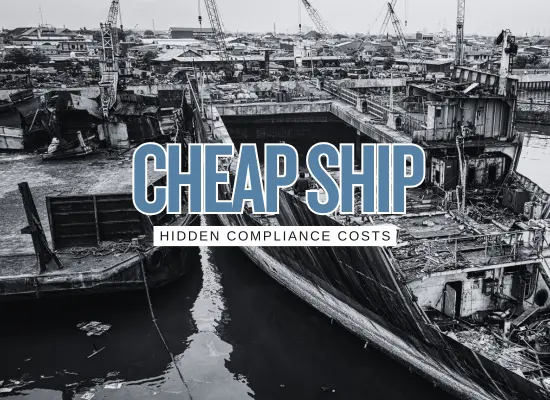

A low-priced ship can look like instant margin, especially when yards are busy and financing is tight. The trap is that “cheap” is often a bundle of future costs that do not show up in the headline price: efficiency gaps, compliance friction, charterer acceptance limits, and unpredictable off-hire. This guide breaks those costs into a pricing grid you can reuse, plus a simple calculator to translate compliance exposure into cash.
“Low capex” is not the same as “low cost.” A cheap ship often comes with an efficiency gap, compliance complexity, and higher probability of off-hire or disputes. If you do not price those correctly at purchase, you end up funding them later when you have less negotiating power.
The cheap ship trap in one page
| Leakage bucket | How it shows up after closing |
|---|---|
| Efficiency gap | Higher fuel consumption, lower speed at same consumption, and reduced ability to win cargo when charterers compare ships side by side. |
| Compliance cash timing | Regulatory exposure turns into cash settlements, internal admin burden, and disputes when voyages or port calls change. |
| Reliability and off-hire | Small defects become schedule disruption. Disruption becomes deductions, missed windows, and rate underperformance. |
| Charterer acceptance friction | Extra vetting, narrower acceptance, more concessions on terms, and less optionality in weak markets. |
| Exit discount | When you need to sell, buyers demand larger discounts because they price uncertainty, not just steel. |
Three outcomes you should underwrite upfront
- Employment stays steady.
- You can pass through most exposure.
- Efficiency gap is manageable.
- You pay the discount back via leakage.
- Off-hire eats your buffer.
- Terms tighten over time.
- Compliance disputes and timing surprises.
- Fixing becomes harder in a soft market.
- Exit becomes buyer-controlled.
The listicle: 12 ways “cheap” turns expensive
Each item includes the trap, what it looks like in operations, and how to price it into your S&P decision. Use this as a buyer’s checklist or an internal IC memo outline.
gap
Efficiency gap that compounds every day
- You price the ship on today’s rate, not on its relative consumption.
- You assume “we can slow steam” without losing commercial position.
- Model an “extra tonnes per day” penalty across realistic trading days.
- Stress fuel price and utilization, not just freight.
exposure
Compliance exposure becomes a cash settlement problem
- You assume all compliance costs are always passed through.
- You do not model the impact of voyage changes and timing of settlement.
- Assign a conservative “absorbed cost” per tonne of CO2 for your trade mix.
- Add an admin and dispute buffer if charters are short or changeable.
friction
Operational constraints replace simple fuel choice
- You treat compliance as a paperwork item rather than an operations item.
- You assume fuel procurement can adapt smoothly across ports and routes.
- Include a “compliance friction” budget per day for EU-heavy employment.
- Ask whether the charterer controls fuel choice. If yes, model higher uncertainty.
risk
Reliability eats your optionality in the worst months
- You assume “normal” off-hire based on a short lookback.
- You ignore how small failures create commercial penalties and deductions.
- Use a downside utilization case and include the costs that still get paid in off-hire.
- Price not just lost revenue, but schedule and relationship damage.
surprise
Special survey scope growth turns a “cheap” deal into a capital call
- You budget a clean survey without true steel condition clarity.
- You ignore yard duration risk and spares lead times.
- Use a budget range with contingency and a “delay” scenario.
- Demand a payback runway. If runway is short, discount harder or do not buy.
tighten
Charterers respond by tightening terms, not by paying more
- You assume the market will always pay a premium for older tonnage.
- You ignore increased vetting, narrower acceptance, and more deductions.
- Model a “rate concession” case alongside fuel and compliance costs.
- Value optionality. A ship that can trade more places is worth more in a soft market.
risk
Weak pass-through clauses convert compliance into disputes
- You rely on “standard wording” that does not match your voyage reality.
- You do not define data sharing, calculation method, or settlement timing.
- Add a “dispute buffer” cost for short or changeable charters.
- Require clear settlement mechanics before you accept EU-heavy employment.
quality
Bad data turns into bad financing and bad pricing
- You cannot defend consumption or emissions numbers with an audit trail.
- You end up negotiating against yourself because your story changes.
- If data is weak, expect higher lender skepticism and buyer discounts.
- Spend early on a clean documentation pack. It is often cheaper than a price haircut.
illusion
“We will retrofit later” is not a plan unless you fund it
- You assume retrofit timing and yard slots will be convenient.
- You ignore off-hire, performance uncertainty, and covenant impacts.
- Price the full cash package: capex, off-hire, and execution risk premium.
- If you cannot fund it in downside, assume it will not happen.
drag
Cheap purchase price does not guarantee cheap financing
- You assume leverage will be easy because the asset is “cheap.”
- You underestimate lender questions around longevity, compliance, and exit.
- Model higher cost of debt and tighter covenants for older, constrained tonnage.
- Value liquidity. Tight headroom is where cheap ships become expensive ships.
ceiling
Your ceiling becomes the weakest charterer acceptance rule
- You underwrite the ship against a broad market that you cannot access.
- One or two rejection reasons define your whole commercial universe.
- Underwrite the ship against the realistic buyer and charterer universe, not the theoretical one.
- When in doubt, discount for “optionalities lost.”
haircut
The exit discount arrives exactly when you need liquidity
- You assume you can always sell quickly at a fair price.
- You ignore how uncertainty and documentation gaps widen discounts.
- Model a soft market exit and add a speed-to-sale discount factor.
- Invest in documentation that reduces “argument risk” with buyers.
A buyer’s decision grid you can reuse
| Dimension | Low risk signal | High risk signal |
|---|---|---|
| Efficiency | Small gap versus peers, stable consumption evidence, and a trade where efficiency is not the first filter. | Large gap, inconsistent evidence, or a segment where charterers compare ships tightly. |
| EU exposure | Low or controllable exposure with clear pass-through and settlement practices. | High exposure with short charters, voyage variability, and weak clause discipline. |
| Reliability | Low off-hire trend, predictable spares, and controlled maintenance. | Recurring defects, long lead time parts, and “unknown scope” vibes. |
| Charterer acceptance | Broad buyer and charterer universe with minimal concessions. | Narrow universe, more vetting, and frequent concessions or deductions. |
| Exit optionality | Saleability within a short window even in a softer market. | Exit depends on perfect market timing or buyer optimism. |
Compliance cost ledger (what to model)
This is a practical ledger, not a legal interpretation. The aim is to prevent “surprise cash asks” that arrive after you buy.
| Ledger line | How it becomes real money |
|---|---|
| Absorbed carbon cost | Any portion you cannot pass through under your charter mix becomes a direct margin drag. |
| Settlement timing | Cash timing mismatches create working capital stress. Stress grows when rates fall. |
| Admin and verification | Data work, reconciliations, and disputes consume time and create billing delay risk. |
| Operational constraints | Fuel choice, route flexibility, and port availability constraints can reduce earnings options. |
| Commercial concessions | Sometimes the cost shows up as lower hire or tighter terms, not as a line item invoice. |
Quick tool: does the purchase discount cover the likely leakage?
This is a screening calculator. It translates (1) extra fuel burn, (2) an assumed carbon cash exposure, and (3) friction and off-hire buffers into an annual leakage estimate. You choose the assumptions to match your trade and charter mix.
How to use this in an S&P negotiation
| Negotiation lever | What to ask for |
|---|---|
| Documentation pack | Stable consumption evidence, trade pattern clarity, class status, and a clean history of off-hire and claims. |
| Scope clarity | Survey and maintenance timeline with realistic budget ranges and known defects identified early. |
| Contract realism | How compliance costs have been handled in practice, including settlement timing and dispute history. |
| Exit realism | What buyer universe exists for this ship in a soft market, and what discount is typical when buyers control timing. |
A “cheap ship” can still be a good trade, but only if the discount is large enough to cover predictable leakage and you can prove, not assume, that compliance costs and operational friction will be controlled under your charter mix. Treat the decision like a package: efficiency, compliance cash timing, reliability, charterer acceptance, and exit optionality. If any one of those is fragile, the right answer is usually a bigger discount, a shorter holding plan, or a different ship.